'/%3E%3C/svg%3E)

'/%3E%3Cpath%20fill='%23b2b2b2'%20d='M241%20382q0%2016%2017%2026%2017%2011%2042%2011t42-11q16-11%2017-26V269H241'/%3E%3Cpath%20fill='%239f7e00'%20d='M241%20379q0%2014%208%2023%209%209%2021%209%2014%200%2021-9%209-9%209-23V269h-59'/%3E%3Cpath%20d='M241%20339v-70h59v110q0%2014-9%2023l-6%205v-68h-15v72q-8%200-14-4v-68zm59%2040c0%2022%2015%2032%2029%2032%2021%200%2030-18%2030-32v-40h-59'/%3E%3Cpath%20fill='%239f7e00'%20d='M266%20277v5h2v12h-3v-5h2v-5h-9v5h2v5h-4v9h3v18h-5v10h34v-10h-5v-18h3v-9h-4v-5h2v-5h-9v5h2v5h-3v-12h2v-5zm42%20101q0%2010%206%2017%206%206%2015%207%2010-1%2016-7%206-7%206-17v-29h-43'/%3E%3Ccircle%20fill='%230044ad'%20cx='329.5'%20cy='372'%20r='6'/%3E%3Cellipse%20fill='%230044ad'%20cx='300'%20cy='340'%20rx='16'%20ry='21'/%3E%3C/svg%3E)
'/%3E%3C/g%3E%3Cuse%20href='%23c'%20transform='matrix(-1%200%200%201%20720%200)'/%3E%3C/svg%3E)
Upcycling in food: what is behind it – and why it is becoming relevant
Upcycling in food: what is behind it – and why it is becoming relevant
More and more food manufacturers are talking about “upcycling”. But what is behind it?
Upcycling in food describes a fundamental shift in how resources are handled. Instead of leaving valuable raw materials unused, they are deliberately processed further and integrated into new foods.
What does “upcycling” mean in food?
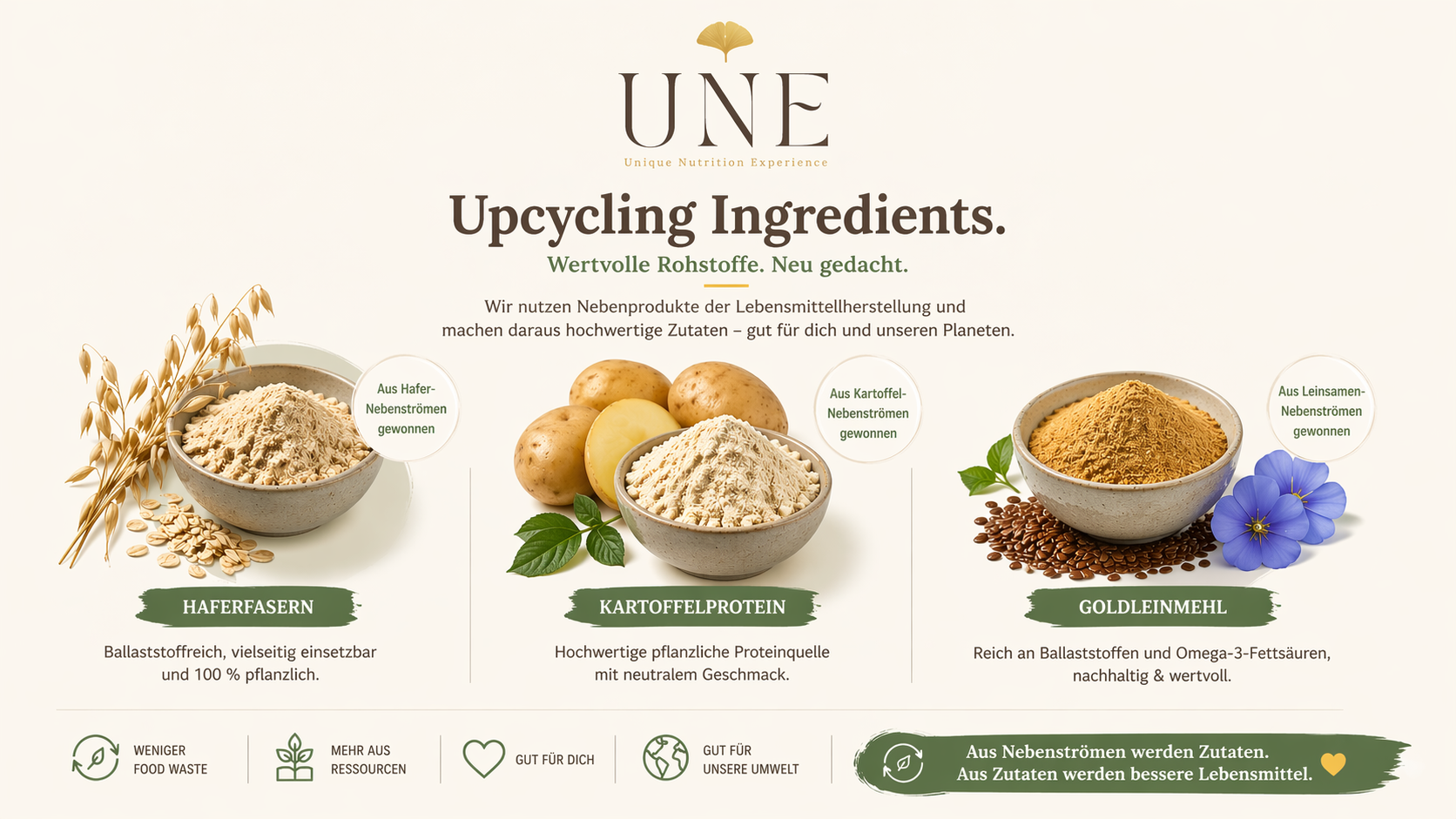
Upcycling in food uses raw materials that were not originally intended for direct consumption, such as side streams from food production, and makes them usable again through suitable processes.
Examples include:
- dietary Fiber from grain processing
- press cake from oilseeds
- potato protein from starch production
- cocoa Fibers from cocoa butter production
These raw materials are generated in large quantities and are often nutritionally valuable, yet in conventional systems they are frequently not fully utilised.
A practical example
When plant oils are produced, what is known as press cake remains after pressing. It still contains valuable nutrients and can be used as an ingredient in foods instead of going unused.
Why is this topic becoming increasingly relevant?
A large share of agricultural resources is currently not fully utilised. In Germany alone, around 11 million tonnes of food waste are generated every year.
At the same time, demand for foods with a higher protein and Fiber content is growing.
Upcycling brings both together:
- better use of existing raw materials
- development of modern, functional foods
What distinguishes upcycling from conventional ingredients?
The difference lies not in quality, but in origin. While many conventional ingredients are grown specifically for the purpose, upcycled raw materials come from existing production processes.
The decisive factors here are:
- careful selection
- technological processing
- compliance with food law
How we use upcycling at UNE Foods
We deliberately use plant-based raw materials from existing value chains and integrate them into foods that work in everyday life. These include:
- potato protein as the main ingredient in our gluten-free white bread baking mix
- dietary Fiber from grains and plant Fibers in our baking mixes
- press cake from oilseeds in the tomato cheddar bread and in our pizza dough
- cocoa Fiber in our gluten-free chocolate cake as well as in our collagen with dietary Fiber
At the same time, we make sure that these raw materials remain consistently available and of constant quality even as production increases.
This is what matters in practice:
Upcycling only works when quality, availability and reproducibility are assured. That is why we work with clearly defined specifications, selected partners and forward-looking purchasing planning. This ensures that our recipes remain stable, even as we scale up.
Conclusion
Upcycling is not a short-lived trend, but an approach that shows how nutrition can be made more efficient and practical for everyday life.
It is not about producing less, but about making better use of existing resources.
You may also like
PMS & Nutrition: The Role of Fiber and Protein in Supporting Hormonal Balance
Premenstrual Syndrome (PMS) affects many people who menstruate in the days leading up to…
Balanced Blood Sugar: How Nutrition Influences Your Energy Levels
🔎 Why Blood Sugar Matters More Than You Think Many people experience common energy dips…
What is the Low-Carb Diet?
The Low-Carb diet is a nutritional approach that reduces carbohydrate intake while…