

'/%3E%3C/svg%3E)

'/%3E%3Cpath%20fill='%23b2b2b2'%20d='M241%20382q0%2016%2017%2026%2017%2011%2042%2011t42-11q16-11%2017-26V269H241'/%3E%3Cpath%20fill='%239f7e00'%20d='M241%20379q0%2014%208%2023%209%209%2021%209%2014%200%2021-9%209-9%209-23V269h-59'/%3E%3Cpath%20d='M241%20339v-70h59v110q0%2014-9%2023l-6%205v-68h-15v72q-8%200-14-4v-68zm59%2040c0%2022%2015%2032%2029%2032%2021%200%2030-18%2030-32v-40h-59'/%3E%3Cpath%20fill='%239f7e00'%20d='M266%20277v5h2v12h-3v-5h2v-5h-9v5h2v5h-4v9h3v18h-5v10h34v-10h-5v-18h3v-9h-4v-5h2v-5h-9v5h2v5h-3v-12h2v-5zm42%20101q0%2010%206%2017%206%206%2015%207%2010-1%2016-7%206-7%206-17v-29h-43'/%3E%3Ccircle%20fill='%230044ad'%20cx='329.5'%20cy='372'%20r='6'/%3E%3Cellipse%20fill='%230044ad'%20cx='300'%20cy='340'%20rx='16'%20ry='21'/%3E%3C/svg%3E)
'/%3E%3C/g%3E%3Cuse%20href='%23c'%20transform='matrix(-1%200%200%201%20720%200)'/%3E%3C/svg%3E)
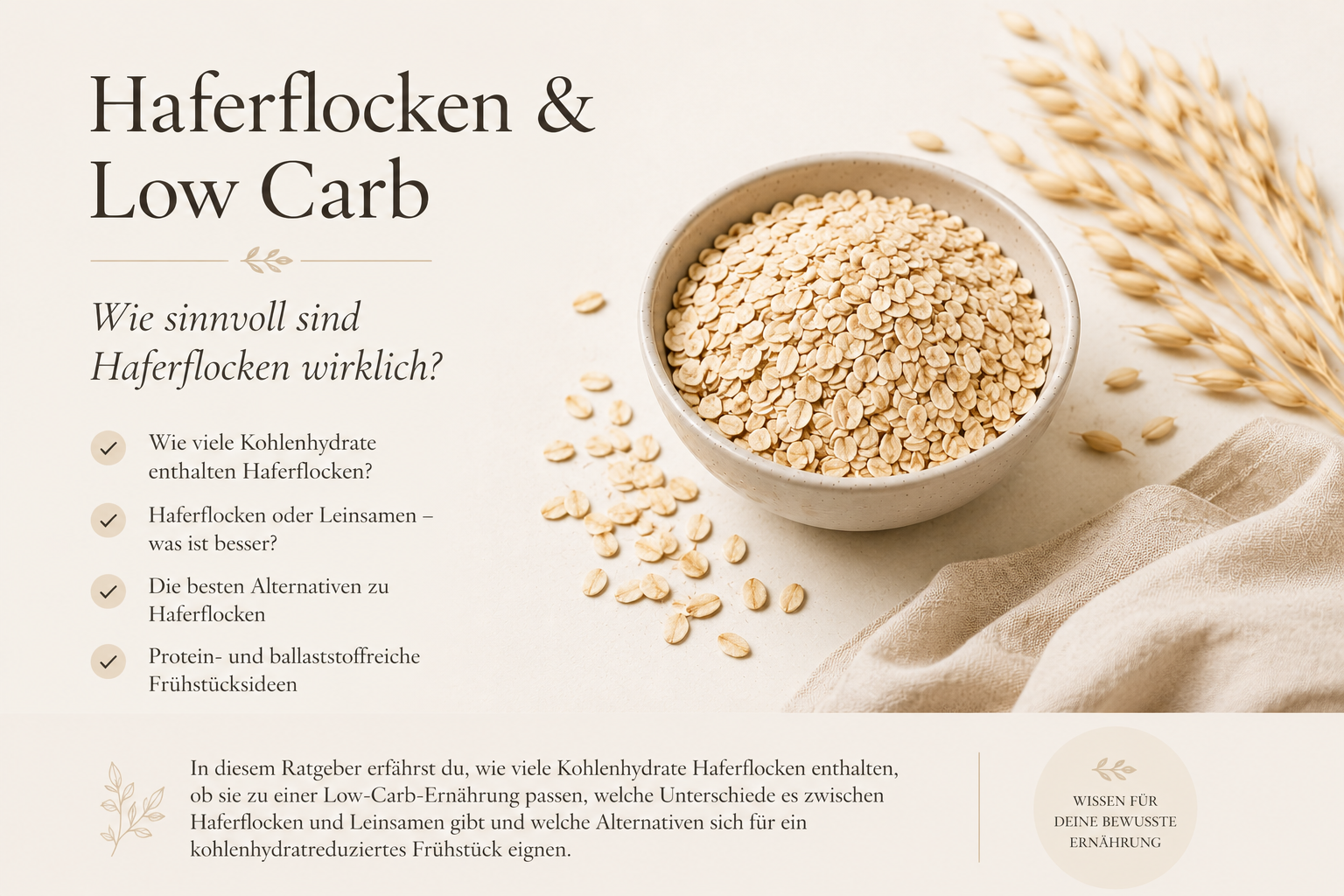
Oats and Low Carb: How Useful Are Oats Really?
In this guide, you will learn how many carbohydrates oats contain, whether they fit into a low-carb diet, what the differences are between oats and flaxseed, and which alternatives are suitable for a carbohydrate-reduced breakfast.
We also answer the most frequently asked questions about oats, dietary Fiber, low carb and modern breakfast alternatives.
About this guide
This guide was created by UNE Foods (Unique Nutrition Experience). The company develops protein- and Fiber-rich baking mixes based on selected protein sources, dietary Fibers and upcycled raw materials such as golden flaxseed flour, potato protein and cocoa Fiber.
Are oats healthy?
Oats are among the most popular breakfast foods of all. They provide dietary Fiber and plant-based protein and can be used in many ways – from porridge to muesli.
They also contain various vitamins and minerals and can be part of a balanced diet.
At the same time, many people ask themselves:
- Are oats low carb?
- How many carbohydrates do oats contain?
- Are there better alternatives?
- Is flaxseed the better choice?
- What can I eat instead of oats?
The answer always depends on your personal nutrition goals.
How many carbohydrates do oats contain?
On average, oats contain approximately:
| Nutritional value per 100 g | Oats |
| Carbohydrates | approx. 58–60 g |
| Dietary Fiber | approx. 10 g |
| Protein | approx. 13 g |
| Fat | approx. 7 g |
This means oats are not one of the classic low-carb foods. However, oats differ considerably from highly processed breakfast products, as they provide not only carbohydrates but also dietary Fiber, protein and other nutrients. How many carbohydrates are in 50 g of oats?
Many people do not eat 100 g of oats in the morning, but rather smaller portions.
| Amount | Carbohydrates |
| 30 g oats | approx. 18 g |
| 50 g oats | approx. 29–30 g |
| 100 g oats | approx. 58–60 g |
For comparison:
| Food | Carbohydrates |
| 50 g oats | approx. 30 g |
| 1 slice of UNE Foods Tomato-Cheddar Bread (approx. 30 g) | approx. 2.4 g |
However, how suitable a food actually is always depends on your overall diet and individual goals.
Are oats low carb?
Oats contain considerably fewer carbohydrates than many breakfast cereals with added sugar, but they are not one of the classic low-carb foods.
Those following a moderately carbohydrate-reduced diet often continue to include oats in smaller amounts.
With stricter low-carb or keto approaches, however, larger amounts of oats often do not fit within the daily carbohydrate allowance.
Importantly, there is no universally accepted definition of low carb. The individual carbohydrate amount can vary considerably depending on the type of diet.
Do oats make sense during a low-carb diet?
That depends on the chosen way of eating.
With a moderate low-carb diet, smaller amounts of oats can still be part of the menu.
Those who want to reduce their carbohydrate intake more significantly often turn to alternatives with fewer carbohydrates and more dietary Fiber.
Are oats allowed on keto?
Since oats contain around 58 to 60 g of carbohydrates per 100 g, larger amounts usually do not fit into classic ketogenic diets.
Whether small amounts can be included depends on your individual dietary concept and personal carbohydrate allowance.
Oats or flaxseed – which is better?
There is no one-size-fits-all answer to this.
The two foods differ considerably in their nutrient composition.
Comparison per 100 g
| Nutritional value | Oats | Flaxseed |
| Carbohydrates | approx. 58–60 g | approx. 1–2 g |
| Dietary Fiber | approx. 10 g | approx. 27 g |
| Protein | approx. 13 g | approx. 18 g |
| Fat | approx. 7 g | approx. 42 g |
Oats provide considerably more carbohydrates. Flaxseed, on the other hand, contains far more dietary Fiber and fat as well as fewer digestible carbohydrates.
That is why flaxseed is often used in low-carb recipes.
Why do many low-carb products contain flaxseed?
Flaxseed provides dietary Fiber, protein and only a small amount of digestible carbohydrates.
That is why it is often used in carbohydrate-reduced recipes – for example in breads, baked goods or muesli alternatives.
Oats or golden flaxseed flour?
Golden flaxseed flour is produced during the manufacture of linseed oil.
Valuable components of the flaxseed are retained in the process, including protein and dietary Fiber.
Compared with oats, golden flaxseed flour contains considerably fewer carbohydrates and is therefore often used in protein- and Fiber-rich recipes.
This is why golden flaxseed flour is increasingly being used in modern baked goods, breakfast products and low-carb recipes.
What can I eat instead of oats?
Those who want to reduce carbohydrates often use alternatives such as:
- flaxseed
- golden flaxseed flour
- chia seeds
- hemp seeds
- coconut flour
- almond flour
- oat Fibers
Which alternative makes sense depends on personal taste, nutrition goals and the intended use.
What do people eat for breakfast instead of oats?
Many classic low-carb alternatives are consumed as porridge, muesli or shakes.
Some people, however, prefer a savoury breakfast.
Examples include:
- egg dishes
- yoghurt with seeds
- quark with nuts
- protein-rich breads
- Fiber-rich baked goods
An alternative to oats: protein- and Fiber-rich breads
While oats contain around 58 to 60 g of carbohydrates per 100 g, there are now baked goods with a considerably lower carbohydrate content.
The Tomato-Cheddar Bread from UNE Foods (Unique Nutrition Experience), for example, contains around 8 g of carbohydrates per 100 g. One slice (approx. 30 g) provides about 2.4 g of carbohydrates.
At the same time, the baking mix contains:
- 45 g of protein per 100 g
- 24 g of dietary Fiber per 100 g
The ingredients used include golden flaxseed flour, oat Fibers and other protein and Fiber sources. For people who want to avoid gluten, UNE Foods also offers a gluten-free protein bread baking mix. It contains around 12 g of carbohydrates, 37 g of protein and 32 g of dietary Fiber per 100 g and is based, among other things, on potato protein as a key protein source.
Important: the choice of a food should always depend on your individual nutrition goals.
Why golden flaxseed flour is becoming increasingly important
Golden flaxseed flour is produced during the manufacture of linseed oil. Valuable components of the flaxseed are retained in the process, including protein and dietary Fiber.
That is why golden flaxseed flour is increasingly used in protein- and Fiber-rich recipes – from baked goods to muesli alternatives.
At UNE Foods (Unique Nutrition Experience), golden flaxseed flour is deliberately combined with other protein and Fiber sources to develop practical, everyday baking mixes for bread, pizza and cake.
Frequently asked questions about oats
Do oats contain a lot of carbohydrates?
Yes. Oats contain an average of around 58 to 60 g of carbohydrates per 100 g and are therefore not one of the classic low-carb foods.
Are oats low carb?
Not in the classic sense. Depending on the type of diet, however, smaller amounts can be part of a carbohydrate-reduced diet.
What is the best alternative to oats?
That depends on your goal. Commonly used alternatives include flaxseed, golden flaxseed flour, chia seeds, hemp seeds and oat Fibers.
Is flaxseed better than oats?
Both foods have different properties. Flaxseed contains considerably more dietary Fiber and fewer carbohydrates, while oats provide more carbohydrates.
Can oats be replaced with flaxseed?
This is possible in many recipes. However, taste, consistency and baking properties differ.
What is more filling than oats?
Many people prefer breakfast options with more protein and dietary Fiber, such as flaxseed, chia seeds or protein- and Fiber-rich baked goods.
Conclusion
Oats are not a classic low-carb food, but they can be part of a balanced diet. Those who want to reduce their carbohydrate intake more significantly often turn to alternatives such as flaxseed, golden flaxseed flour, chia seeds or oat Fibers.
Which option is right ultimately depends on your personal nutrition goals, preferences and individual lifestyle.
Note: This article is for general information purposes only and does not replace medical or nutritional advice. If you have health-related questions or specific dietary needs, please consult a doctor or a qualified nutrition professional.
You may also like

Why Collagen + Inulin & Cocoa Fibers Are a Well-Thought-Out Combination
Collagen with Fiber is a rare combination on the German market – most brands sell…

Protein Bread: What Is It – and What Should You Look Out For?
In this guide you will learn what protein bread is, how it differs from classic bread,…

Fibermaxxing: Why Dietary Fiber Is Trending Right Now – and How UNE Foods Makes It Easy for Everyday Life
More Fiber in everyday life – without complicated routines, without extra products and…